
How to apply for and keep a Primary Mining Licence in Tanzania
A Primary Mining Licence is a legal right, with a map, a term and duties — not a handshake over a pit.

A hole in the ground is not a licence. A story about a family pit is not a licence. A Primary Mining Licence (PML) is a right the Mining Commission grants over a defined area, for a defined term, to a person or company the law allows to hold it. The duties start when the grant is issued, and they do not pause because the work is small.
This explainer is general information for Tanzanian small-scale miners, possible applicants, partners, investors, students and the public. It is not an application form, a fee schedule, a completed cadastre filing or legal advice. Forms, fees and procedures are set by the Mining Commission. Use the official channels, and check the law in force on the day you file.
What you will be able to do
After this explainer you should be able to:
- State who may hold a PML, how long it lasts, how large it may be, and what “small-scale” means in the Act (initial capital not exceeding USD 5 million).
- Decide, in outline, when a Prospecting Licence, a Mining Licence or a Special Mining Licence is the better tool.
- List the main materials the Mining Act requires in a PML application, and name the official cadastre and forms — without inventing a fee.
- Explain the duty to commence mining within six months of grant (or any longer period the Commission permits), and to apply to renew not later than three months before expiry.
- Explain why a land-use deal or a handshake is not a substitute for a verified licence, and how a lawful technical-support agreement sits on a named PML held by the registered holder.
First principles: a right, a map, and a duty
Start with who may hold the right. A PML is reserved for Tanzanian citizens and companies whose members, directors and control are Tanzanian (Mining Act, Cap. 123, s.8 and the PML provisions in ss.54–56). It is a licence for small-scale mining, with an initial capital not exceeding USD 5 million.
Then look at the ground. The licence runs for 7 years and may be renewed. The maximum area is 10 hectares for minerals other than building materials. Those figures come from the Act and the Commission’s published types of licence; always confirm them before you file, because regulations can change the detail around the edge.
Then accept the duty. The holder must commence mining within six months of grant, or such other period as the Commission permits (s.55(5) as amended). The exclusive right is over the licensed area only. Renewal must be applied for not later than three months before expiry (s.56(1)). Inactive licences can be revoked.
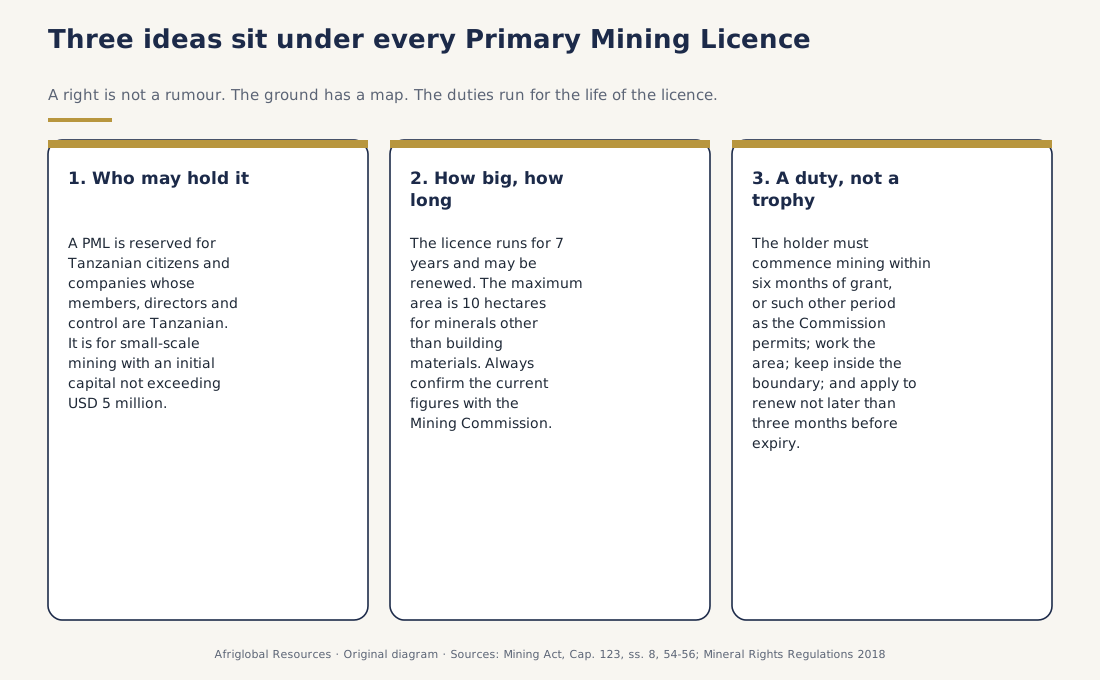
A picture to keep
A PML is less like a trophy on the wall and more like a lease over a marked field. The paper is only as good as the map, the term and the work you actually do inside the boundary.
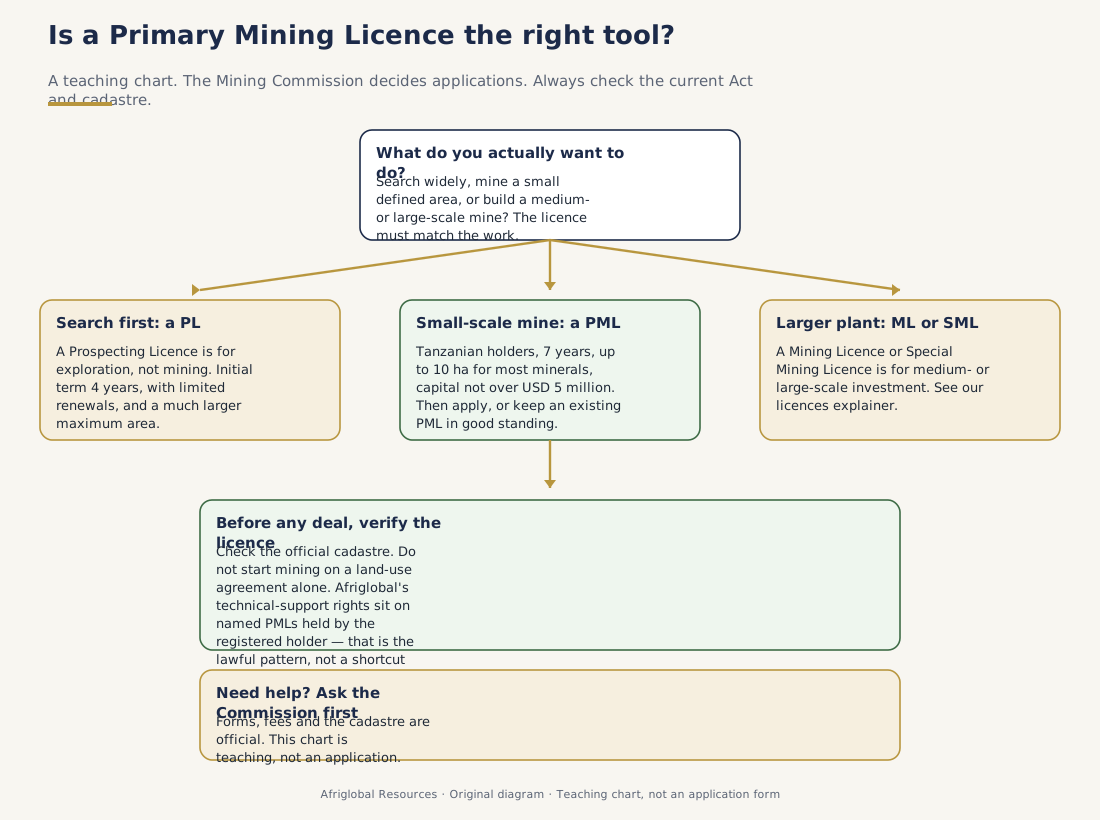
Is a Primary Mining Licence the right tool?
If you need to search a large area, you need a Prospecting Licence, not a PML. A PL is for exploration. It does not allow mining. Its initial term is 4 years, with limited renewals, and a much larger maximum area (up to 300 km² for most metallic minerals under the 2018 Mineral Rights Regulations).
If you plan a medium- or large-scale mine, you need a Mining Licence or a Special Mining Licence. An ML is for capital between USD 100,000 and USD 100 million, typically for up to 10 years. An SML is for capital of at least USD 100 million, with a term tied to the life of the ore body or the period requested. See our explainer on mining licences in Tanzania for the four-rung ladder.
1. Check the ground on the cadastre
Before you spend money on a sketch, open the official Online Mining Cadastre Portal (OMCTP) and, if you need help, a regional Commission office. See whether the ground is already held, what mineral right sits on it, and whether the story you have been told matches the register.
Do not start mining on a land-use agreement alone. A village letter, a family understanding or a private “share of the pit” does not create a mineral right. The cadastre is the place to look first — and again, before any partnership.
2. Prepare the prescribed file
The Mining Act requires, in outline, the official form and the prescribed fee, a description and sketch plan of the area, an integrity pledge, a local-content plan, identity or company papers, and environmental investigations, a social study and an environmental protection plan. That is a complete official file, not a conversation in a corridor.
This article does not invent application fee amounts. Pay only the prescribed fee, on the official channel. Official application and renewal forms are published by the Commission at tumemadini.go.tz/publications/forms. The Commission’s Types of Licences page is the right starting point for current categories, not an unofficial copy of a form.
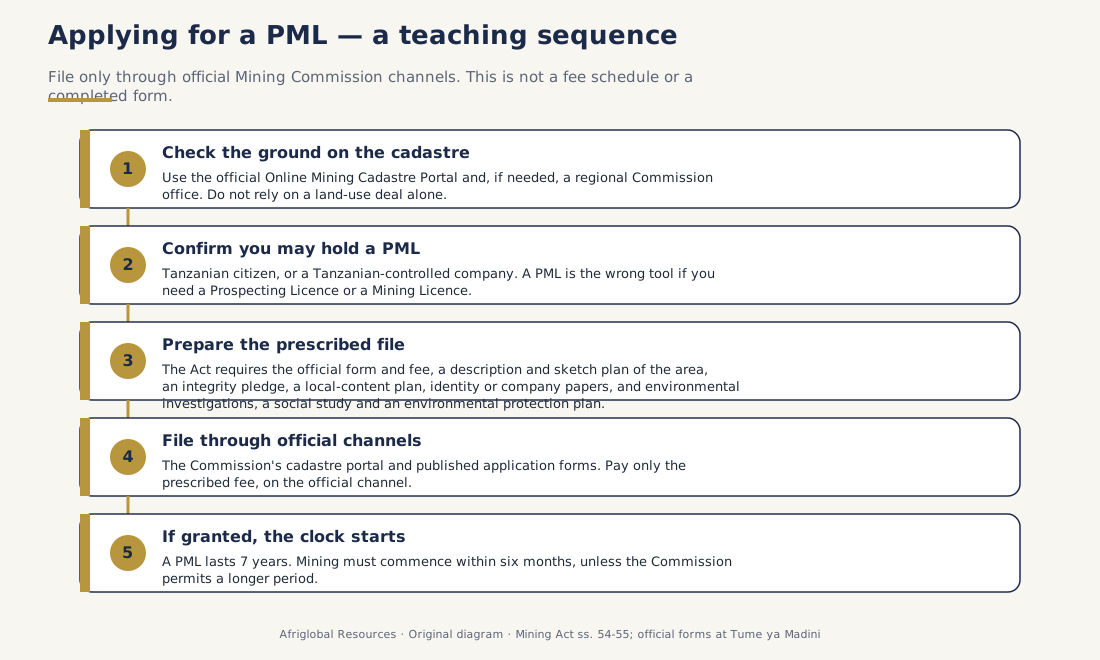
3. If granted, the clock starts
A PML lasts 7 years from grant. Mining must commence within six months, unless the Commission permits a longer period. “Commence” is not a ceremonial first shovel for a photograph. It is the start of the work the licence authorises, inside the boundary, in a way you could explain to an inspector.
Stay inside the map. Demarcate the area. The exclusive right does not travel with you to the next valley.
4. Keeping the licence in good standing
The licence is a continuing duty, not a one-time stamp. Work the ground with diligence — inactive licences can be revoked. Protect people and the environment; the protection plan you filed is part of the bargain. When you sell minerals, sell lawfully to a licensed dealer or broker through official markets, and pay royalties and other charges when they fall due. Our explainer on selling gold in Tanzania covers official counters, royalties and the 20% domestic rule.
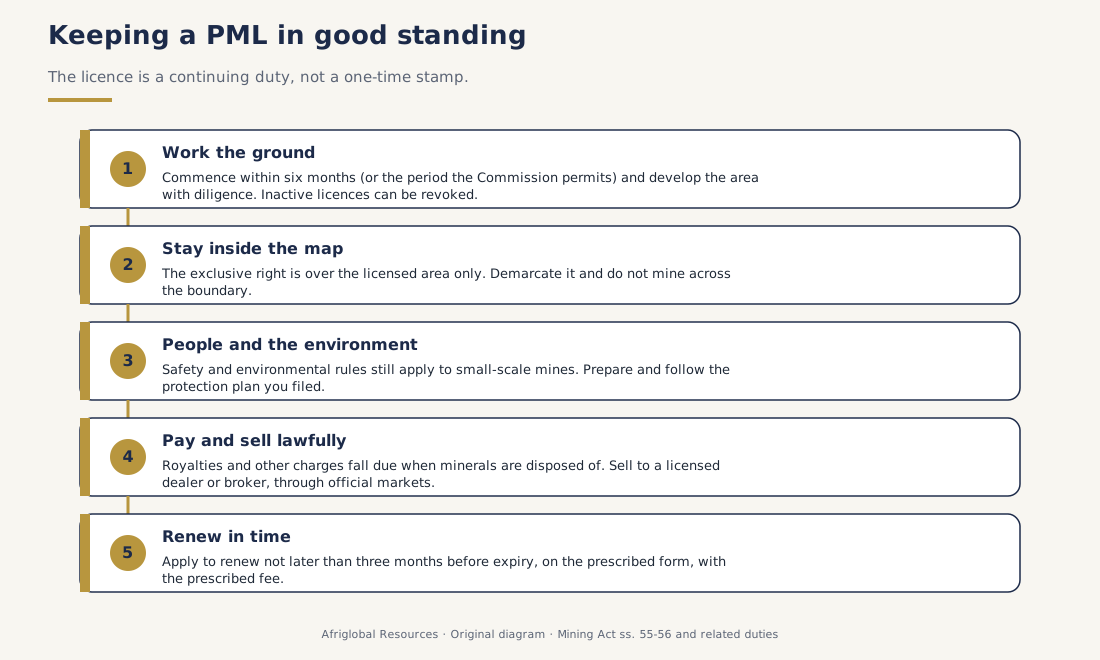
5. Renew at least three months early
Apply to renew not later than three months before expiry, on the prescribed form, with the prescribed fee (s.56(1) and the official form notes). Waiting until the last week is how a working pit becomes an argument with the register. If you are in any doubt about dates, ask the Commission, in writing, early.
This calendar is assumed so you can see the deadlines. It is not a granted licence, not a Kitete date, and not a promise from the Commission.
Suppose a PML were granted on 1 January 2027, for the ordinary 7-year term, with no special commencement period.
The six-month commencement deadline would fall on 1 July 2027, unless the Commission permitted longer.
The licence would expire on 1 January 2034. A renewal application would need to be filed not later than 1 October 2033 — three months before expiry.
The lesson is to put both dates in a diary the day the grant arrives. The Commission’s own forms and letters are the authority; this arithmetic is only a teaching picture of ss.55(5) and 56(1).
6. Partnerships and technical support — the lawful pattern
Foreign investors do not hold PMLs. The lawful pattern is a verified licence in the name of a Tanzanian holder, plus a written technical-support or similar agreement that the Commission can recognise. Always check the cadastre and the papers before any deal. A promise of “we have a pit” is not due diligence.
That is the pattern at Chunya–Makongorosi. The Primary Mining Licences are held by the registered licence holder, Mr Yusuf Hassan Mohamed. Afriglobal holds technical-support rights over 18 PMLs under the Technical Support Agreement of 13 November 2025 and its addenda of 19 June and 30 September 2026. Technical support on 10 PMLs is authorised by the Mining Commission (MC/TSA/121-2026); authorisation for the other 8 is being sought. Licence copies are on file for 15 PMLs. That is not a shortcut around the Commission; it is the Commission’s own path.
What this means
- For small-scale miners and applicants: confirm you may hold a PML, check the cadastre, file a complete official application, start work within the time allowed, stay inside the boundary, and renew at least three months early.
- For investors and partners: do not treat a land-use deal as a mineral right. Verify the licence, then document support in a form the Commission can authorise. Afriglobal’s TSA sits on named PMLs held by the registered holder.
- For students and the public: a PML is a 7-year, small-scale right over a mapped area, reserved for Tanzanian holders, with duties that run for the life of the licence.
Quick tip: you can look up a licence number on the official cadastre, or start from our mining intelligence dashboard, then still confirm on the Commission’s portal.
Common mistakes
- Mining on a handshake or a land-use letter without a mineral right on the cadastre.
- Applying for a PML when you need a PL, an ML or an SML — or the other way around.
- Filing an incomplete file, or paying a “facilitator” instead of the prescribed fee on the official channel.
- Waiting more than six months to commence, without the Commission’s permission, or leaving the licence idle.
- Mining across the boundary, or treating the paper as a trophy while the ground is left unmarked.
- Applying to renew in the last weeks of the term, or not applying at all.
- Entering a partnership without checking the register and the Commission’s authorisation for technical support.
Lawful holding, in brief
Use official channels only. The cadastre, the published forms and the Commission’s offices are the path. This article is not a form and not a fee schedule.
Safety and the environment still apply. A small-scale licence does not set those duties aside. See our explainer on underground shaft essentials if the work goes underground.
This is not legal advice. The Mining Act, the Mineral Rights Regulations and the Commission’s current procedures govern every application. Check them before you file or deal.
Key takeaways
- A PML is a legal right over a mapped area, reserved for Tanzanian citizens or Tanzanian-controlled companies, for small-scale mining with initial capital not over USD 5 million.
- It lasts 7 years, renewable, with a maximum area of 10 hectares for most minerals. Confirm current figures with the Commission.
- File a complete official application through the cadastre and published forms. Do not invent a fee; do not start on a land-use deal alone.
- Commence mining within six months of grant, or any longer period the Commission permits. Stay inside the boundary. Renew not later than three months before expiry.
- Foreign partners do not hold PMLs. The lawful pattern is a verified Tanzanian holder plus a technical-support agreement the Commission can authorise.
Glossary
| English | Kiswahili | In this article |
|---|---|---|
| Primary Mining Licence (PML) | Leseni ya uchimbaji mdogo (PML) | A small-scale mining right for Tanzanian holders; 7 years, renewable; generally up to 10 hectares. |
| Prospecting Licence (PL) | Leseni ya utafutaji (PL) | A right to search, sample and test; it does not allow mining. |
| Mining Licence (ML) | Leseni ya uchimbaji (ML) | A medium-scale mining right (capital USD 100,000–100 million). |
| Special Mining Licence (SML) | Leseni maalum ya uchimbaji (SML) | A large-scale mining right (capital at least USD 100 million). |
| Cadastre (OMCTP) | Daftari la leseni (OMCTP) | The official Online Mining Cadastre Portal at portal.madini.go.tz. |
| Integrity pledge | Ahadi ya uadilifu | A prescribed declaration required with the application. |
| Local-content plan | Mpango wa maudhui ya ndani | The plan the Act requires as part of the application file. |
| Commencement | Kuanza uchimbaji | The duty to start mining within six months of grant, or such other period as the Commission permits. |
| Renewal | Kuhuisha | A fresh application, due not later than three months before expiry. |
| Technical Support Agreement (TSA) | Mkataba wa Msaada wa Kiufundi (TSA) | A lawful way for a technical partner to support a named PML held by the registered holder, subject to Commission authorisation. |
| Registered holder | Mmiliki aliyesajiliwa | The person or company in whose name the licence stands on the cadastre. |
Check what you have learned
Five questions. Choose one answer each, then check. This is a self-test, not a certificate.
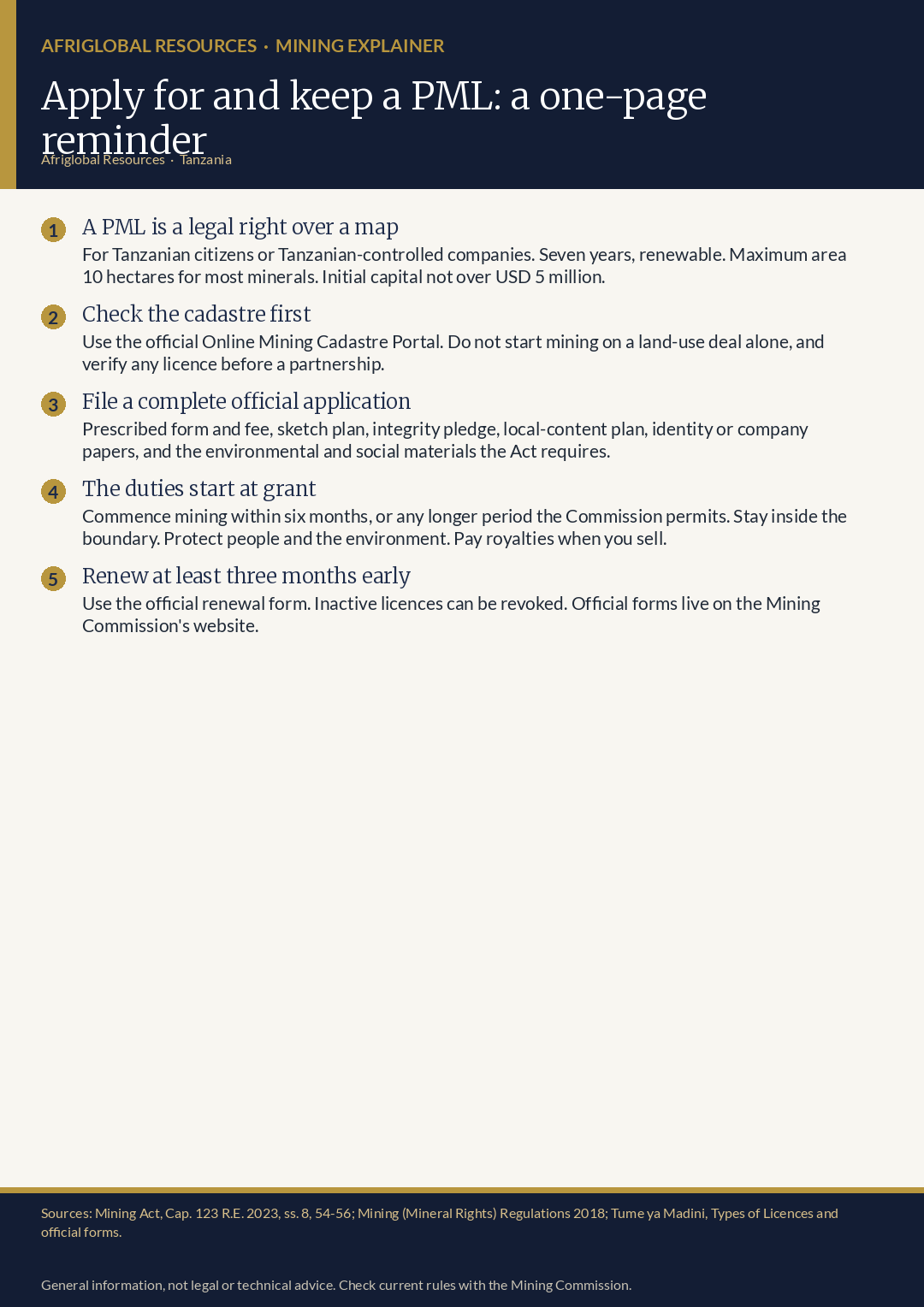
One-page summary
A single printable sheet: who may hold a PML, the cadastre, the application file, commencement, renewal and the lawful partnership pattern. Useful for a classroom, a site office or a briefing pack.
Looking ahead in Tanzania
The future of small-scale mining in Tanzania is formal. A mapped, current licence, a file you can show, and a sale at an official counter are not paperwork for their own sake. They are how a mine stays open, how mercury-free processing can be financed, and how a partner can support the work without pretending to hold a right the law reserves for Tanzanian holders. The miners who treat the cadastre as seriously as the pit will still be on the register when the next inspection comes.
Data belongs in that future too. A licence number, a commencement date and a renewal reminder are as much a part of a professional small-scale mine as a crusher or a vat.
Afriglobal Resources in Chunya
The Primary Mining Licences (PMLs) are held by the registered licence holder, Mr Yusuf Hassan Mohamed. Afriglobal holds technical-support rights over 18 PMLs under the Technical Support Agreement of 13 November 2025 and its addenda of 19 June and 30 September 2026. Technical support on 10 PMLs is authorised by the Mining Commission (MC/TSA/121-2026); authorisation for the other 8 is being sought. Licence copies are on file for 15 PMLs.
Proposed first-phase expansion: development of the Kitete mine and a proposed 200 TPD CIP processing plant at Umoja (Makongorosi). This is a proposal, not current capacity; it is subject to financing, an independent Competent Person review, exploration drilling, assays and QA/QC (all still to be completed), and approvals. Project financing for this phase is being sought. There is an existing vat-leach facility at Umoja (Makongorosi). No grade or Mineral Resource has been declared.
Read more on our projects page, or our explainers on PL, PML, ML and SML, selling gold in Tanzania and underground shaft essentials. Contact us to arrange a site visit.
Kwa Kiswahili (makala kamili)
Toleo kamili la makala hii — si muhtasari tu — lipo kwa Kiswahili: Jinsi ya kuomba na kuweka leseni ya PML ikiwa hai Tanzania.
Sources: The Mining Act, Cap. 123 R.E. 2023, ss. 8, 54–56 (and s.55(5) as amended on commencement; s.56(1) on renewal); Tume ya Madini, Types of Licences; Tume ya Madini, official forms; Online Mining Cadastre Portal; Mining (Mineral Rights) Regulations 2018, summary by FB Attorneys. Site facts about the PMLs, the Technical Support Agreement, the Umoja vat-leach facility and the proposed 200 TPD CIP plant are as stated on our projects page. This article is general information, not legal advice or an application; check current rules, forms and fees with the Mining Commission. The worked calendar uses assumed dates only. No application fee amounts are stated here because they must be read from the official schedule.
Questions about investing in Tanzanian gold?
Talk to our team about our projects in Chunya and Handeni, or arrange a site visit.