
Underground shaft essentials at a small gold mine in Tanzania
A shaft must breathe, stay open, and bring people home. Underground mining is a system: air, water, ground and hoisting. This is an explainer, not a construction manual.

A hole in the ground is not yet a workplace. Until air moves, water is managed, the ground is held, and the hoist can bring people back to surface, it is only an opening — and an opening can become a trap. The first rule of this article is the last one too: when in doubt, stay on surface and call competent help.
This explainer is general information for small-scale miners, PML holders, supervisors, investors, students and visitors. It is not a construction drawing, a shaft-sinking method, a winch catalogue, a blasting manual or a safety certificate. Some underground tasks require separate legal authority. This article does not teach them. Sizes, rope duties, support patterns and pump selections must be designed by competent people for that ground, under the law.
What you will be able to do
After this explainer you should be able to:
- Explain, from first principles, why a shaft is a system of air, water, ground and hoisting — not just a hole and a rope.
- Read a labelled, conceptual shaft section and name the headframe, collar, conveyance, hoist house and sump, without treating the picture as a design.
- State that Tanzania’s 2010 mine-safety regulations require ventilation of every place people work or travel, an emergency plan, and annual training in self-rescue apparatus authorised by the Chief Inspector.
- Explain why deep shafts often pump water in stages, as an idea, not as a do-it-yourself design.
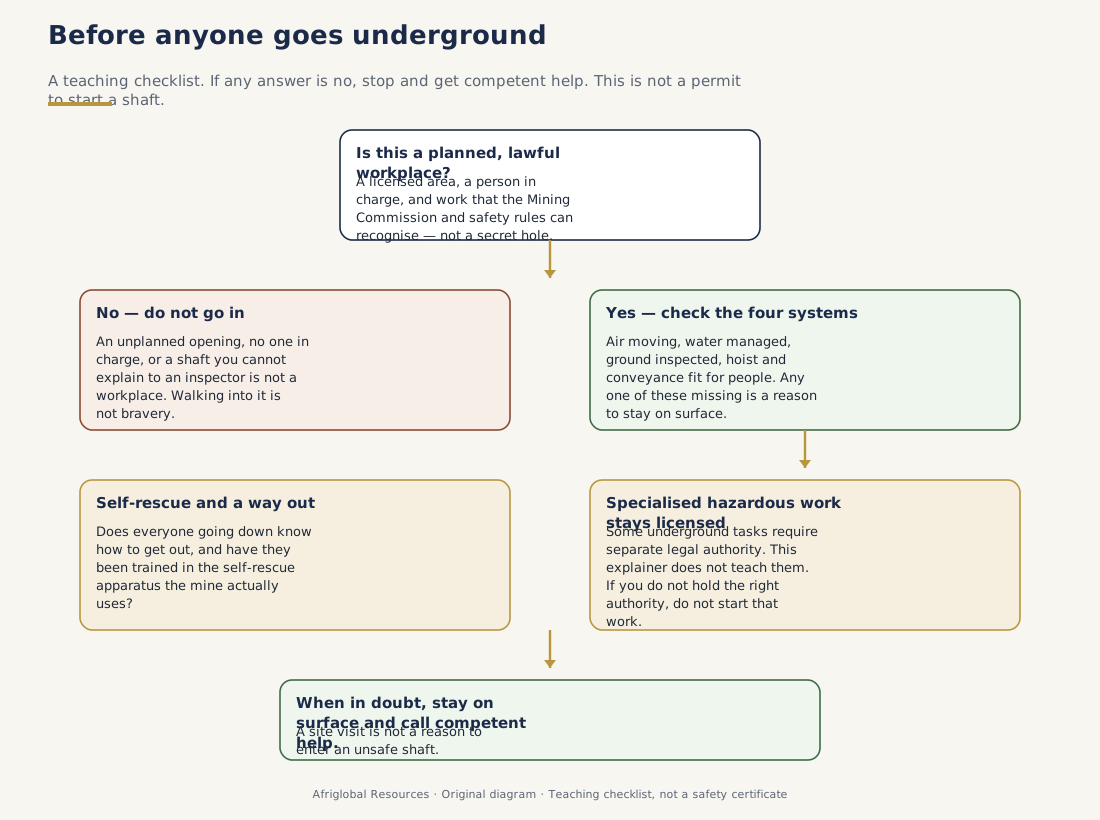
- Use a simple “go / no-go” checklist, and know that specialised hazardous work stays with people who hold the right legal authority.
First principles: four systems, one workplace
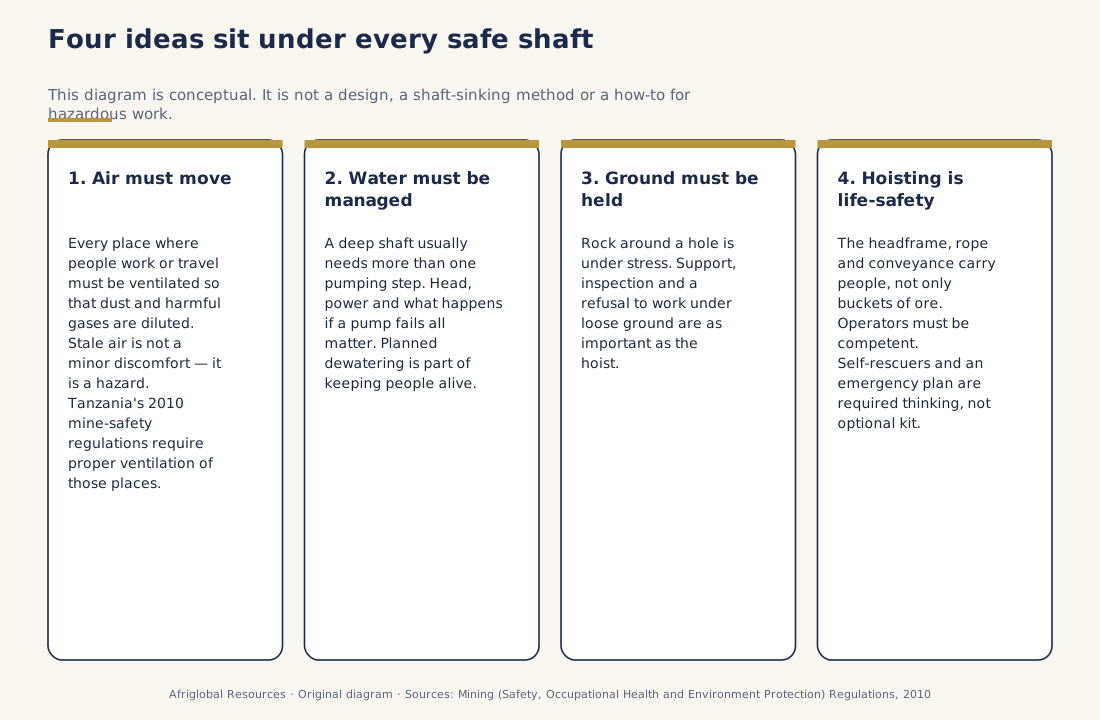
People cannot work where the air is stale, dusty or short of oxygen. Ventilation is a duty, not a luxury. Tanzania’s Mining (Safety, Occupational Health and Environment Protection) Regulations, 2010 (GN 408) require proper ventilation of every place where people work or travel, so that dust and harmful gases are diluted.
Water rises. A deep shaft usually needs more than one pumping step, because every extra metre of lift costs energy and stresses the pump and the pipe. Planned dewatering is part of keeping people alive, not an afterthought when the sump overflows.
Rock around a hole is under stress. Support, inspection and a refusal to work under loose ground are as important as the hoist. And the hoist itself is life-safety equipment: the headframe, rope and conveyance carry people, not only buckets of ore. Operators must be competent. Self-rescuers and an emergency plan are required thinking, not optional kit.
A picture to keep
A shaft is more like a well that people have to climb into and out of, every shift, with air that must be changed like the air in a room with no windows. If the room cannot breathe, or the ladder cannot be trusted, no one should go in to “just have a look.”
1. A small shaft, in outline — not a design
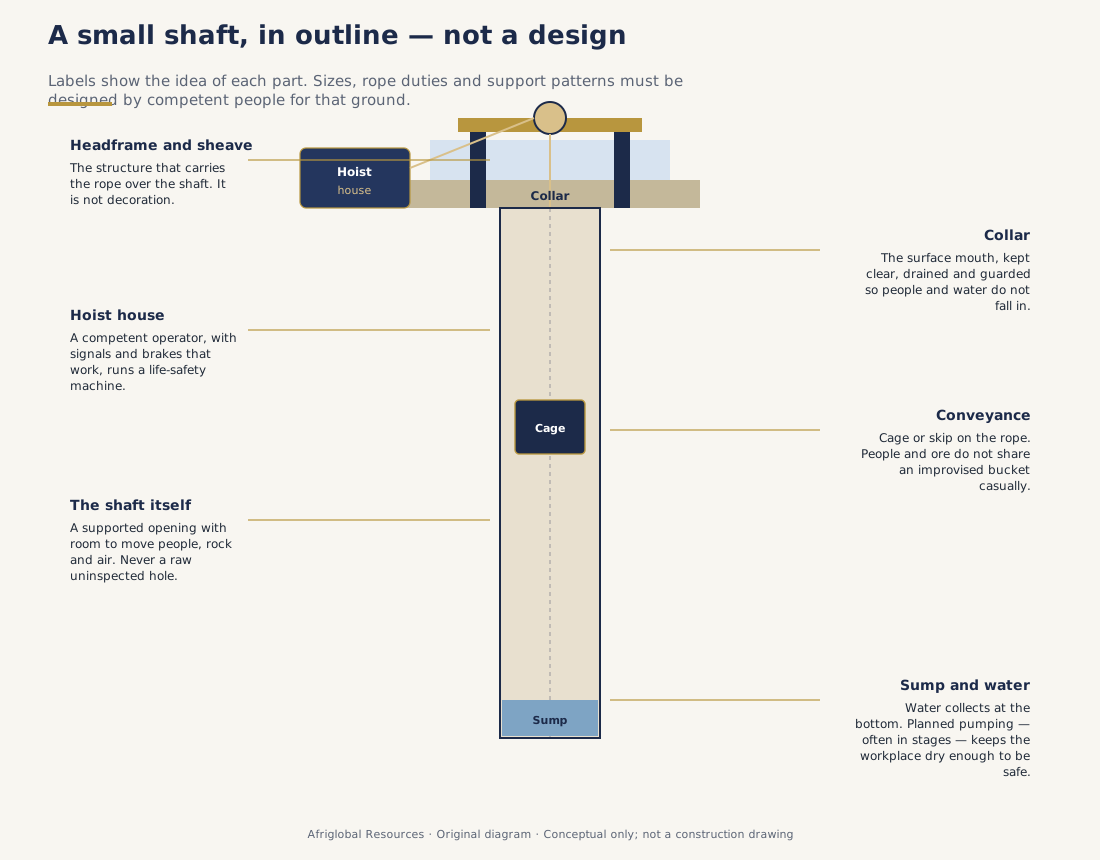
The picture below names the parts so you can talk about them. It does not give sizes, rope duties or a support pattern. Those belong to a competent designer who has seen that ground.
At the surface sit the headframe and sheave, which carry the rope, and the hoist house, where a competent operator runs a life-safety machine with signals and brakes that work. The collar is the mouth of the shaft: it must be kept clear, drained and guarded so people and water do not fall in. Below, a supported shaft gives room to move people, rock and air — never a raw, uninspected hole. The conveyance (a cage or skip on the rope) is how people and ore travel; they do not share an improvised bucket casually. At the bottom, a sump collects water that must be pumped on a plan.
2. Air must move
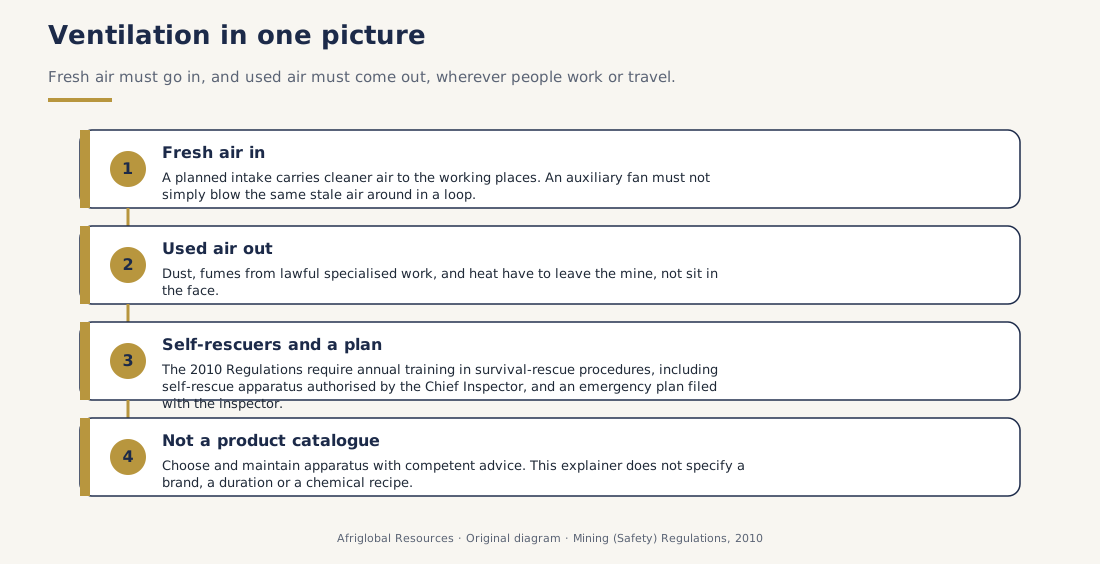
Fresh air has to go in, and used air has to come out, wherever people work or travel. An auxiliary fan must not simply blow the same stale air around in a loop. Dust, heat, and fumes from any lawful specialised work have to leave the mine, not sit in the face.
The 2010 Regulations also require an emergency plan, and annual training in survival-rescue procedures, including self-rescue apparatus authorised by the Chief Inspector. Choose and maintain that apparatus with competent advice. This explainer does not specify a brand, a duration or a chemical recipe.
3. Why deep shafts often pump in stages
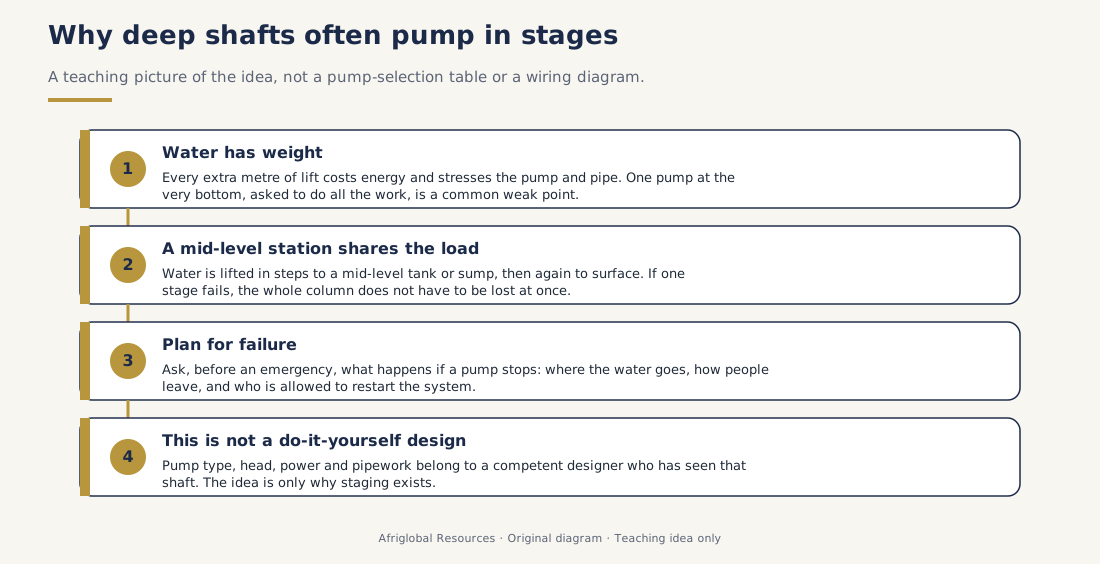
Water has weight. One pump at the very bottom, asked to lift the whole column to surface, is a common weak point. A mid-level station can share the load: water is lifted in steps to a mid-level tank or sump, then again to surface. If one stage fails, the whole column does not have to be lost at once.
Plan for failure before an emergency: where the water goes, how people leave, and who is allowed to restart the system. Pump type, head, power and pipework belong to a competent designer who has seen that shaft. The idea here is only why staging exists.
These depths are assumed so you can see the idea of staging. They are not measurements from Kitete, not a pump duty, and not a design you should copy.
Suppose a teaching shaft were 40 metres deep, with water collecting in a sump at the bottom.
A single pump asked to lift all 40 metres does all the work, and all the risk, in one machine. A mid-level station at, say, 20 metres — a teaching number only — would split that lift into two shorter stages.
If the lower stage failed, people still need a way out, and water still needs a place to go, before anyone tries to restart a pump. That is the point of the picture: staging is about load and failure, not about buying a particular machine from a webpage.
Do not size a pump, a pipe or a cable from this paragraph. If the shaft you are looking at has water in it and no clear plan, stay on surface.
4. Ground and hoisting
Inspect the ground. Support it in the way a competent person has specified for that rock. Refuse to work under loose ground. A photograph of timber or rock-bolts is not a specification.
The hoist is not “just a winch.” Hoist competence, signals, brakes, and a conveyance fit for people are life-safety questions. The 2010 Regulations also address breathing apparatus in hoist rooms and, at stated thresholds, mine-rescue team arrangements. Read the Regulations, or have them read with you by someone who is competent, rather than inventing a rule of thumb.
5. Specialised hazardous work stays licensed
Some underground tasks need separate legal authority and specialist competence. This explainer does not teach those tasks, name methods, or list products. If you do not hold the right authority, do not start that work. Outline only: it is a licensed activity, and it is not part of “having a look down the shaft.”
What this means
- For small-scale miners and supervisors: do not treat a hole as a workplace until air, water, ground and hoisting are in a planned, lawful state. When in doubt, stay on surface.
- For investors and visitors: a site visit is arranged; it is not a reason to enter an unsafe opening. Ask how ventilation, dewatering, support and hoisting are managed before anyone goes down.
- For students and the public: four systems must work together. The law already requires a ventilation duty, an emergency plan and self-rescue training.
Quick tip: if you cannot explain to an inspector how the air moves, how the water is pumped, how the ground is held and who is competent on the hoist, no one should go in.
Common mistakes
- Treating an unplanned opening as a workplace, or going in “just to look.”
- Copying a shaft photograph or this diagram as a construction design.
- Running a fan in a loop that only circulates stale air, and calling it ventilation.
- Relying on one bottom pump for a deep lift, with no thought about what happens if it stops.
- Using an improvised conveyance for people, or letting an untrained person run the hoist.
- Skipping self-rescue training and an emergency plan because “the shaft is small.”
- Starting specialised hazardous work without the legal authority that work requires.
Safety, in brief
When in doubt, stay on surface. A website is not a reason to enter a shaft. Competent design, lawful authority and inspection come first.
The 2010 Regulations already require a plan: ventilation of places where people work or travel, emergency plans, and annual training in self-rescue apparatus authorised by the Chief Inspector.
This is not a construction, shaft-sinking or blasting manual, and it is not a product catalogue. Specialised hazardous work stays licensed. If you need help, stop and get it from people who are competent and authorised.
Key takeaways
- A shaft is a system: air, water, ground and hoisting. A hole is not yet a workplace.
- The labelled section in this article is conceptual, not a design or a construction drawing.
- The 2010 mine-safety regulations require ventilation of every place people work or travel, an emergency plan, and annual self-rescue training with authorised apparatus.
- Deep shafts often pump in stages so that no single machine carries the whole lift — an idea, not a do-it-yourself design.
- When in doubt, stay on surface. Specialised hazardous work stays with people who hold the right legal authority.
Glossary
| English | Kiswahili | In this article |
|---|---|---|
| Shaft | Shimo / kisima cha chini ya ardhi | A vertical or near-vertical opening used to move people, rock and air. |
| Headframe | Kichwa cha shimo | The surface structure that carries the hoist rope over the shaft. |
| Collar | Mdomo wa shimo | The surface mouth of the shaft, which must be kept clear, drained and guarded. |
| Hoist | Winch / mashine ya kuinua | The life-safety machine that raises and lowers the conveyance. |
| Conveyance (cage or skip) | Kizimbi au skip | The carrier on the rope for people and/or rock. |
| Sump | Dimbwi | The collection point for water at the bottom of the shaft. |
| Ventilation | Uingizaji hewa | A planned flow of fresh air in and used air out of every workplace and travelway. |
| Staged dewatering | Kutoa maji kwa hatua | Pumping water in more than one lift, often via a mid-level station. |
| Self-rescue apparatus | Vifaa vya kujinusuru | Apparatus authorised by the Chief Inspector, with annual training required under the 2010 Regulations. |
| Emergency plan | Mpango wa dharura | The plan the 2010 Regulations require, to be filed with the inspector. |
| Competent person | Mtu mwenye ujuzi | Someone with the training, experience and authority to do or supervise that task safely and lawfully. |
Check what you have learned
Five questions. Choose one answer each, then check. This is a self-test, not a certificate.
One-page summary
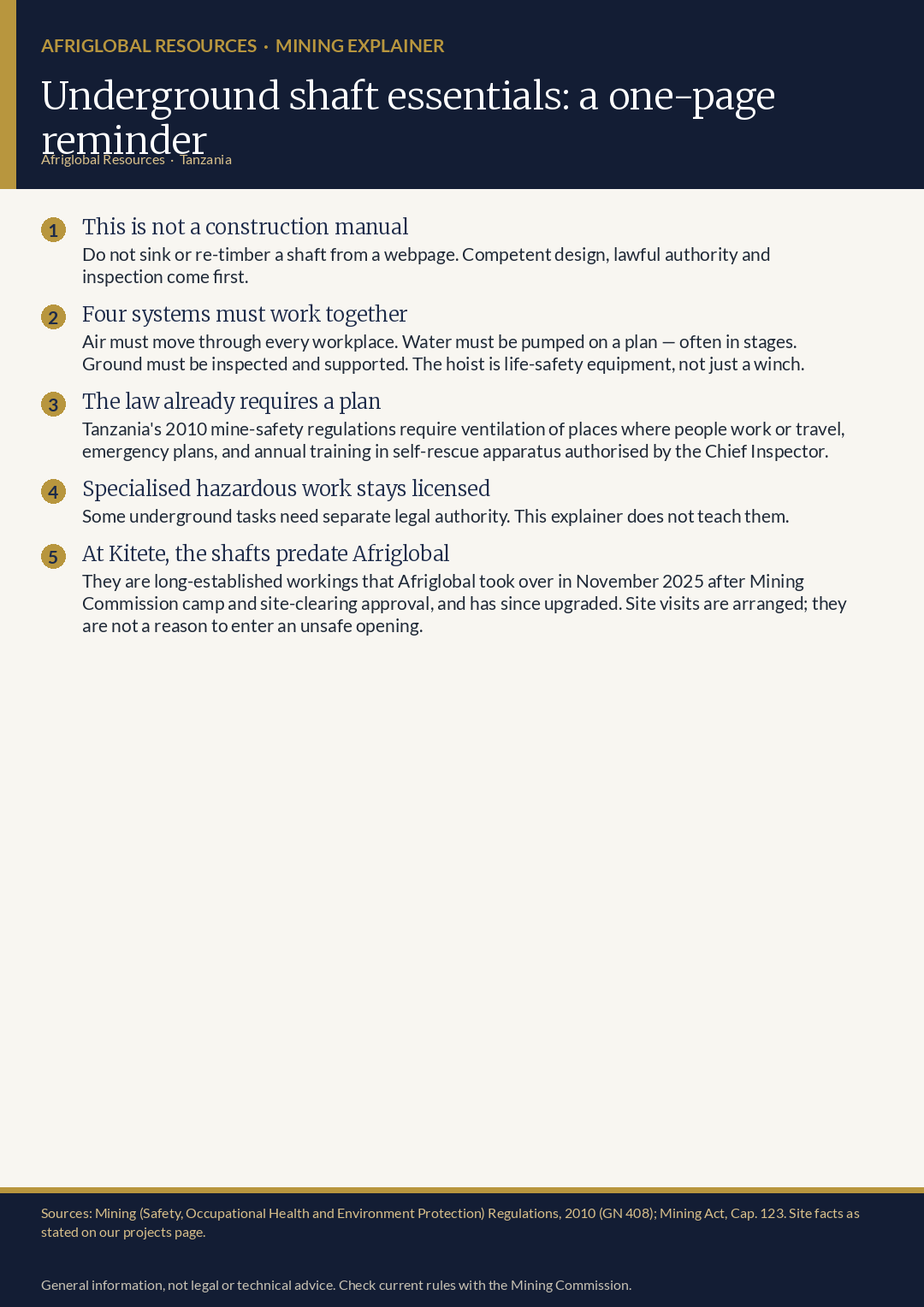
A single printable sheet: the four systems, the legal duties in outline, staged dewatering as an idea, and the rule to stay on surface when in doubt. Useful for a classroom, a site office or a briefing pack — not a construction sheet.
Looking ahead in Tanzania
The future of small-scale underground gold in Tanzania is formal, inspected and data-driven. A shaft that can be explained to an inspector — how the air moves, how the water is pumped, how the ground is held, who is competent on the hoist — is the same shaft that can support mercury-free processing and a lawful sale. Informal openings, untrained hoisting and “we will fix the air later” belong to the past.
Professional standards are not a luxury reserved for large mines. They are how people come home, and how a small mine stays on the register.
Afriglobal Resources in Chunya
The Kitete shafts are long-established underground workings that predate Afriglobal’s involvement. Following the Mining Commission’s camp and site-clearing approval, Afriglobal took over these workings in November 2025 and has since upgraded them to professional operating standards.
The Primary Mining Licences are held by the registered licence holder, Mr Yusuf Hassan Mohamed. Afriglobal holds technical-support rights over 18 PMLs under the Technical Support Agreement of 13 November 2025 and its addenda of 19 June and 30 September 2026. Technical support on 10 PMLs is authorised by the Mining Commission (MC/TSA/121-2026); authorisation for the other 8 is being sought. Licence copies are on file for 15 PMLs.
Proposed first-phase expansion: development of the Kitete mine and a proposed 200 TPD CIP processing plant at Umoja (Makongorosi). This is a proposal, not current capacity; it is subject to financing, an independent Competent Person review, exploration drilling, assays and QA/QC (all still to be completed), and approvals. Project financing for this phase is being sought. There is an existing vat-leach facility at Umoja (Makongorosi). No grade or Mineral Resource has been declared. Site visits are arranged; they are not a reason to enter an unsafe opening.
Read more on our projects page, or our explainers on how to apply for and keep a PML, mercury-free gold recovery and CIP vs vat leaching. Contact us to arrange a site visit.
Kwa Kiswahili (makala kamili)
Toleo kamili la makala hii — si muhtasari tu — lipo kwa Kiswahili: Mambo muhimu ya shimo la chini ya ardhi kwenye mgodi mdogo wa dhahabu Tanzania.
Sources: The Mining Act, Cap. 123 R.E. 2023; Mining (Safety, Occupational Health and Environment Protection) Regulations, 2010 (GN 408), including duties on ventilation of places where people work or travel, emergency plans, annual training in self-rescue apparatus authorised by the Chief Inspector, hoist competence, and related mine-rescue provisions. Site facts about the Kitete shafts, the PMLs, the Technical Support Agreement, the Umoja vat-leach facility and the proposed 200 TPD CIP plant are as stated on our projects page. This article is general information, not a design, a construction or shaft-sinking manual, a product catalogue, or a safety or training certificate. It does not teach specialised hazardous work. Check current rules with the Mining Commission and the Chief Inspector, and take competent, authorised advice before any underground work. The worked depths are teaching assumptions only.
Questions about investing in Tanzanian gold?
Talk to our team about our projects in Chunya and Handeni, or arrange a site visit.